The urethra is the vessel responsible for transporting urine from the bladder to an external opening in the perineum. It is lined by stratified columnar epithelium, which is protected from the corrosive urine by mucus secreting glands.

Male Urethra

The male urethra is approximately 15-20cm long. In addition to urine, the male urethra transports semen – a fluid containing spermatozoa and sex gland secretions.

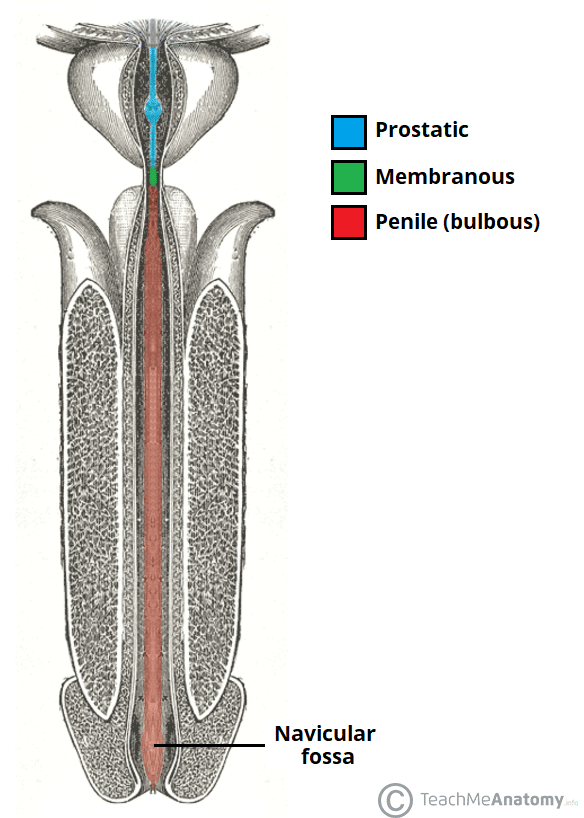
According to the latest classification, the male urethra can be divided anatomically into three parts (proximal to distal):

  • Prostatic urethra:
    • Begins as a continuation of the bladder neck and passes through the prostate gland.
    • Receives the ejaculatory ducts (containing spermatozoa from the testes and seminal fluid from the seminal vesicle glands) and the prostatic ducts (containing alkaline fluid).
    • It is the widest and most dilatable portion of the urethra.
  • Membranous urethra:
    • Passes through the pelvic floor and the deep perineal pouch.
    • Surrounded by the external urethral sphincter – which provides voluntary control of micturition.
    • It is the narrowest and least dilatable portion of the urethra.
  • Penile (bulbous) urethra:
    • Passes through the bulb and corpus spongiosum of the penis, ending at the external urethral orifice (the meatus).
    • Receives the bulbourethral glands proximally.
    • In the glans (head) of the penis, the urethra dilates to form the navicular fossa.

Female Urethra

In females, the urethra is relatively short (approximately 4cm). It begins at the neck of the bladder, and passes inferiorly through the perineal membrane and muscular pelvic floor. The urethra opens directly onto the perineum, in an area between the labia minora, known as the vestibule.

Within the vestibule, the urethral orifice is located anteriorly to the vaginal opening, and 2-3cm posteriorly to the clitoris. The distal end of the urethra is marked by the presence of two mucous glands that lie either side of the urethra – Skene’s glands. They are homologous to the male prostate.

Medika Life

Medika Life is a digital Health Publication for both the medical profession and the public. Make informed decisions about your health and stay up to date with the latest developments and technological advances in the fields of medicine.

Recent Posts

At HLTH Europe, the Most Important AI Story Was Happening Beyond the Headlines

Artificial intelligence was impossible to miss at HLTH Europe in Amsterdam. It appeared on the…

4 days ago

At HLTH Europe, BBC StoryWorks Shines a Light on Women’s Health and the Challenge of Navigating Care

Conversations about women's health are not new. Researchers, clinicians, patient advocates and policymakers have spent…

5 days ago

The Fire That Changed American Business

On March 25, 1911, flames tore through the Triangle Shirtwaist Factory on the eighth floor of Manhattan’s…

5 days ago

The Weight-Loss Drug Nobody Warned You About: When the Scale Goes Down, and Your Sight Goes With It

You go to sleep one night feeling fine. When you wake up the next morning,…

5 days ago

At HLTH Europe, Briya Opens No-Cost Access to AI-Powered Research

As HLTH Europe opens this week in Amsterdam, bringing together health leaders, innovators, investors and…

7 days ago

Machine Deep Learning or Deep Learning of Humans? Which is Correct: “Machine Deep Learning” or “Deep Learning of Humans”?

The term “deep learning” is one layer of artificial intelligence. In fact, deep learning is…

7 days ago

This website uses cookies. Your continued use of the site is subject to the acceptance of these cookies. Please refer to our Privacy Policy for more information.

Read More